
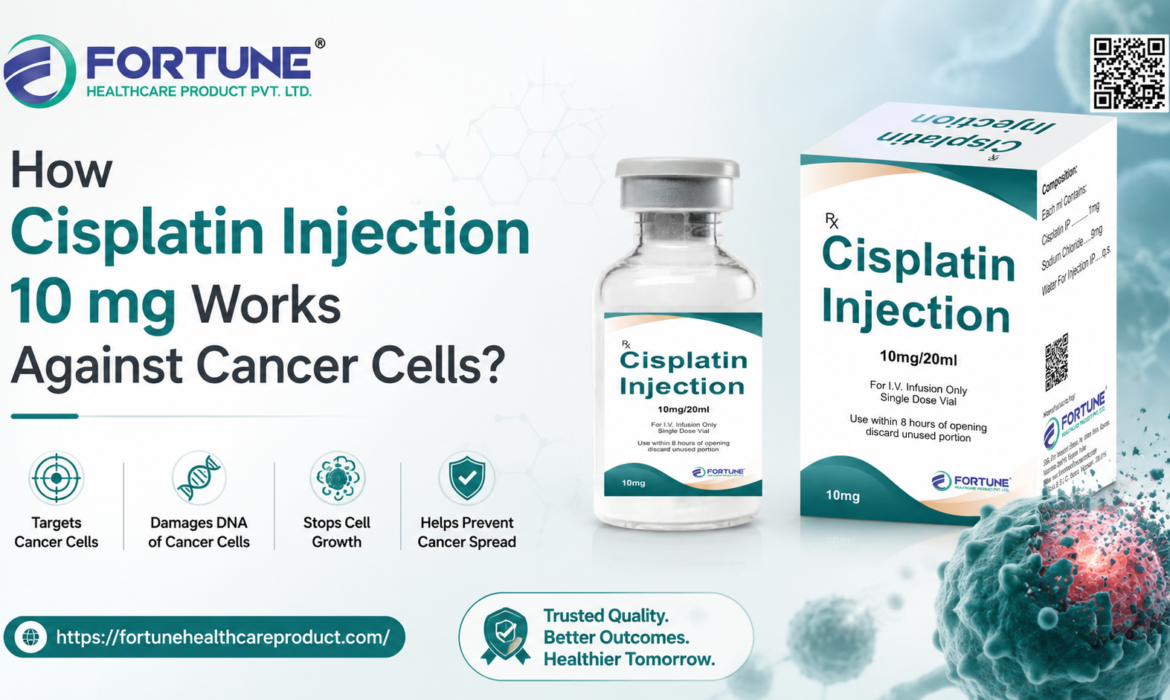
How Cisplatin Injection 10 mg Works Against Cancer Cells?
Cisplatin injection 10 mg is a platinum-based chemotherapy medicine, used in treatment plans across several cancer types. The way it works is fairly specific: it damages the DNA inside cancer cells, and without intact DNA to copy, those cells can’t divide or grow the way they normally would. Whether it’s the right choice for someone comes down to the cancer type, how far it’s progressed, the person’s general health, and what their oncologist decides after weighing everything. This article walks through the underlying science in plain language education, not a substitute for medical advice.
What Is Cisplatin?
Oncologists have relied on cisplatin, a platinum-containing chemotherapy medicine, for decades in treatment protocols for solid tumours. What sets it apart from classic alkylating agents is how directly it interacts with DNA.
The “10 mg” refers to the listed product strength. It should not be interpreted as the dose a patient will receive, because cisplatin dosing is determined individually by the oncology team. That figure isn’t the dose a patient ends up receiving; oncology teams work out actual doses individually, weighing body surface area, kidney function, and the treatment protocol in use. This medicine is meant only for administration under the supervision of trained healthcare professionals, in a hospital or comparable clinical setting.
What Cisplatin Does Inside a Cancer Cell?
Once the medicine enters the body, a chain of events follows. Cisplatin travels through the bloodstream after intravenous delivery, reaching tissue throughout the body not just the tumour. Inside a cell, it undergoes a chemical change that leaves it far more reactive, then binds to DNA, forming platinum-DNA cross-links. Those cross-links distort the DNA structure enough to throw off replication and transcription. Fast-dividing cancer cells struggle to copy damaged DNA accurately, and when the damage is severe or beyond repair, it can push the cell toward apoptosis, its own programmed shutdown.
Think of DNA as an instruction manual a cell must copy before it can split in two; cisplatin tears pages out of that manual, so the copy comes out wrong. This is a rough analogy: cisplatin isn’t selective about which cells it damages, and any cell undergoing DNA replication is fair game, which is why side effects show up in healthy tissue too.
Why Are Cancer Cells Vulnerable to Cisplatin?
Cancer cells may be particularly vulnerable because they frequently replicate their DNA and may be less able to tolerate or repair extensive DNA damage. However, sensitivity varies considerably between tumours and also depends on drug uptake, DNA-repair mechanisms and cell-death pathways. More division means more openings for cisplatin to interfere, and once cross-link damage builds up, dividing normally isn’t possible anymore. A lot of cancer cells also have weaker DNA-repair systems, so the damage rarely gets fixed in time.
Still, tumours don’t all respond the same way cancer type and biology both affect how well treatment works, which is why oncologists don’t treat every case identically. It’s not only cancer cells that are affected, either: bone marrow and digestive-tract cells divide quickly too, and get caught in the crossfire, accounting for a fair share of treatment side effects.
Which Cancers May Be Treated With Cisplatin?
Depending on the treatment plan, cisplatin may come into play for testicular, ovarian, bladder, lung, head and neck, or cervical cancers, among other solid tumours. The Fortune Healthcare Product page lists advanced cancer of the bladder, ovaries, or testicles as the treatment area. Beyond that, indications, combinations, dosing schedule, and duration are decisions made by oncology professionals, guided by prescribing information and clinical protocols.
How Is Cisplatin Administered?
Cisplatin is typically delivered by IV infusion in a hospital, cancer centre, or other equipped setting never at home, never without a clinical team. This includes dose calculations based on body surface area, a kidney function check, hydration before and after, blood and electrolyte checks, anti-nausea medicine as needed, and close observation throughout. This article doesn’t cover dosing formulas or preparation procedures that’s the domain of trained clinical staff.
Why Is Monitoring Important During Treatment?
Since cisplatin doesn’t limit its effects to cancer cells alone, monitoring is critical, not an afterthought. Clinicians track kidney function, hearing, nerve function, blood counts, electrolytes, hydration, and overall tolerance feeding into whether the plan continues as scheduled or needs adjusting.
Possible Side Effects of Cisplatin
Patients may experience nausea, appetite loss, fatigue, kidney issues, hearing changes or ringing in the ears, tingling, lower blood-cell counts, higher infection risk, anemia, electrolyte imbalances, or allergic reactions. This isn’t exhaustive, and no single patient is likely to experience all of it. If anything feels severe or unusual, reach out to the oncology team.
Why Is Cisplatin Combined With Other Cancer Treatments?
Cisplatin rarely stands alone in a treatment plan. Combining it with other chemotherapy drugs, radiation, or surgery is common practice going after cancer from more than one angle at once tends to work better than a single method. That said, it’s not without a cost: mixing treatments changes the side-effect picture, so monitoring doesn’t ease up just because more than one therapy is involved.
Can Cancer Cells Become Resistant to Cisplatin?
Cancer cells can, over time, adapt in ways that make cisplatin less effective resistance, in other words. This happens a few ways: the cell absorbs less of the drug, flushes out more of what gets in, repairs DNA more efficiently, or shifts its cell-death pathways. It’s part of why oncologists track response and adjust course if a tumour stops cooperating.
Cisplatin Product Overview
Here’s what’s currently listed for cisplatin on Fortune Healthcare Product Pvt. Ltd.’s product page:
- Product name: Cisplatin Injection 10 mg
- Strength: 10 mg
- Packaging: One injection in a vial
- Composition: Cisplatin
- Product category: Anti-cancer medicine
- Listed treatment area: Advanced cancer of the bladder, ovaries, or testicles
This is simply what’s listed on the product page, not a claim that the product suits any particular patient that calls an oncologist after proper evaluation.
Important Safety Information
- Cisplatin is a prescription oncology medicine, given only under professional supervision with appropriate hydration, monitoring, and supportive care.
- Patients should tell their healthcare team about kidney, hearing, or nerve conditions, infections, allergies, pregnancy, breastfeeding status, and other medicines.
- Nothing here substitutes for a conversation with an oncologist.
- Institutions and buyers must independently confirm registration, documentation, and regulatory requirements in their market.
Conclusion
At a fundamental level, cisplatin injection 10 mg works by forming platinum-DNA cross-links that damage DNA and interfere with both replication and cell division. Because this effect isn’t limited to cancer cells, close monitoring of kidney function, hearing, blood counts, and general tolerance stays essential throughout treatment. None of this replaces the judgment of a qualified oncologist, who ultimately decides whether cisplatin is right for a particular patient. Hospitals, distributors, importers, and institutional buyers can review the product page or contact Fortune Healthcare Product Pvt. Ltd. for business enquiries.
Frequently Asked Questions
What does cisplatin do to cancer cells?
It attaches to DNA and forms platinum-DNA cross-links, which throws off replication and makes it hard for cancer cells to divide; severe damage can even push a cell toward programmed death.
Can cisplatin cause hearing problems?
Hearing changes and ringing in the ears are recognised possible effects, so hearing is often monitored along the way.
What does cisplatin do to cancer cells?
It attaches to DNA and forms platinum-DNA cross-links, which throws off replication and makes it hard for cancer cells to divide; severe damage can even push a cell toward programmed death.
What is cisplatin injection 10 mg used for?
It’s used as part of treatment plans for several solid tumours — testicular, ovarian and bladder cancers most commonly, and sometimes lung, cervical, or head and neck cancers too. Which one applies depends entirely on the diagnosis and the protocol the oncology team has chosen.
Does the 10 mg strength mean every patient gets a 10 mg dose?
No — that’s a common mix-up. The 10 mg refers to what’s in the vial, not what any given patient actually receives. The real dose gets worked out individually, based on things like body surface area, kidney function and whatever else is part of the treatment schedule.